The strongest argument for the electric car may eventually be the one that hurts aftersales most: total cost of ownership.
Today, that argument is not yet convincing for everyone. Purchase prices remain high, charging can be expensive, and the infrastructure is still not satisfactory for all drivers.
But let us consider a scenario, not a forecast.
Assume that in roughly three years three things come together: charging infrastructure becomes sufficient for most drivers, energy costs fall, and genuinely affordable EVs reach the market.
At that point, the TCO of a BEV could become decisively lower than that of a combustion car. New-car demand might then change very quickly.
What would that mean for aftersales?
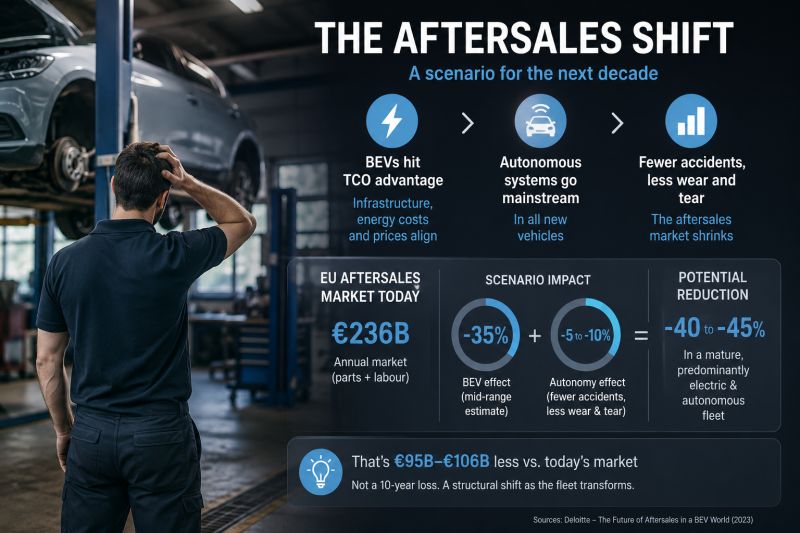
Europe’s automotive aftermarket is worth about €236 billion a year. Deloitte estimates that workshop revenue from a BEV could be 30–45% lower than from a combustion vehicle. Traditional maintenance alone may fall to just 10–20% of today’s level per vehicle.
Take the middle of that range: 35%.
In a mature, predominantly electric fleet, that would represent more than €80 billion of today’s market.
Now add a second assumption.
At roughly the same time, increasingly capable autonomous safety systems become cheap enough to enter nearly every new vehicle.
That should mean fewer avoidable accidents, smoother acceleration and braking, and less wear and tear. Individual repairs may become more expensive because of sensors and complex components, but the number of repair events could still fall.
Assume that this reduces the remaining wear-and-tear and collision business by another five to ten percentage points of today’s market.
The mature aftermarket could then be 40–45% smaller per vehicle: roughly €95–106 billion less than today.
This is not a ten-year forecast. The existing fleet will remain on the road for a long time, and ageing combustion vehicles may initially generate more work.
But the tipping point in new-car sales could arrive much earlier than the full effect becomes visible in workshops.
We usually discuss electrification, autonomy and aftersales separately.
Perhaps we should not.
Together, they could reshape one of Europe’s largest automotive value pools much faster than any of them would alone.