Everyone is quoting the wrong 20%.
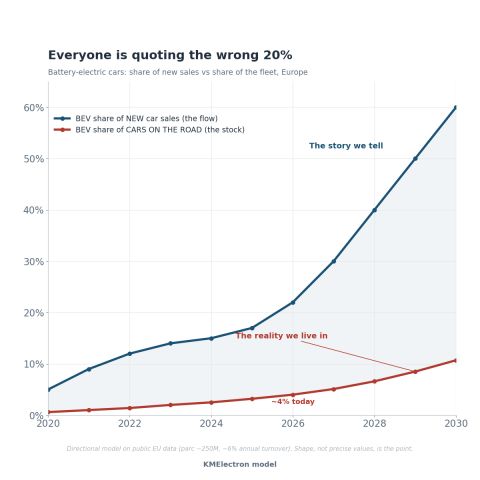
This year, roughly one in five new cars sold in Europe is fully electric. The headlines call it the tipping point, the moment the transition became unstoppable.
But "20% of new cars" and "20% of cars on the road" are completely different numbers - and the gap between them is the most important thing nobody is talking about.
Here is why. New cars are a flow. The cars already on the road are a stock. Europe has around 250 million cars in that stock, and it replaces barely 6% of them each year. So even with one in five new cars now electric, battery-electric vehicles are only about 4% of the cars actually driving on European roads today.
Four percent.
The blue line below - EVs as a share of new sales - is the story we tell each other: steep, exciting, heading past 60%. The red line - EVs as a share of the cars actually out there - is the story we live: it crawls, and even on an optimistic path it reaches only around 10-11% by 2030.
That gap is not a failure. It is arithmetic. A fast-moving flow takes many years to fill a slow-moving stock.
But it changes everything about what comes next. Because almost every plan we have made - for charging, for the grid, for used cars, for residual values - is quietly built on the blue line. And we are going to live on the red one.
The transition is not arriving. It is barely beginning. That is not a reason for doubt - it is the reason the hardest and most interesting part is still ahead of us.
Over the next days I want to follow that red line into the places it actually leads: fuel, the grid, the cost of driving, and who feels it first.